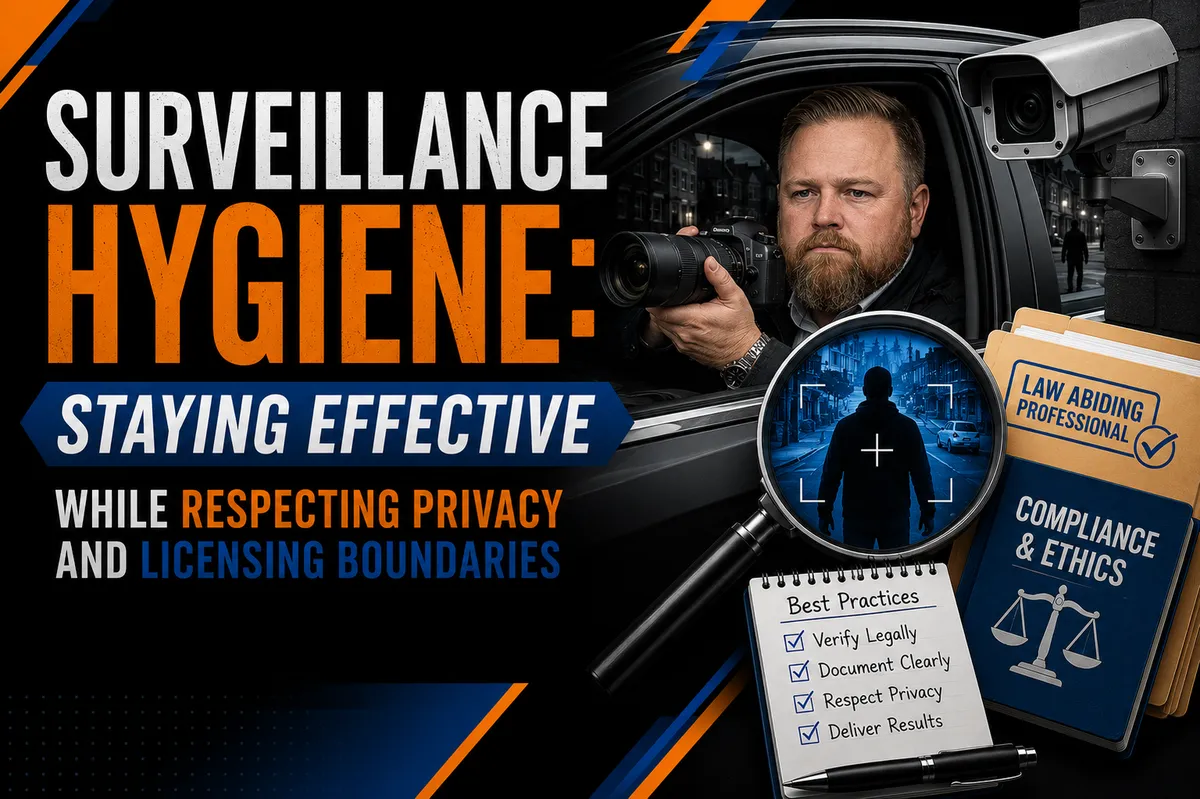
Surveillance Hygiene: Staying Effective While Respecting Privacy and Licensing Boundaries
By Mighty Mike Reid
Surveillance Hygiene: Staying Effective While Respecting Privacy and Licensing Boundaries
Private investigators and legal support professionals operate in an environment where effectiveness and legality must always work together. Clients expect results, but those results must withstand scrutiny from courts, regulators, opposing counsel, and the public.
That is why surveillance hygiene has become one of the most important concepts in modern investigative work.
A strong surveillance hygiene program helps investigators gather useful information while respecting privacy rights, licensing restrictions, and professional standards. It is also a powerful business differentiator. Law firms, insurance carriers, and corporate clients increasingly prefer investigators who can demonstrate that their methods are both effective and defensible.
Introduction to Surveillance Hygiene
In today's legal environment, surveillance is about more than observation. It requires a commitment to ethics, compliance, and professionalism.
Surveillance hygiene refers to the policies, procedures, and habits that ensure investigative work is conducted legally, ethically, and responsibly. It includes respecting privacy rights, following licensing requirements, maintaining accurate records, and protecting sensitive information.
For investigators and legal professionals, surveillance hygiene helps create work product that can withstand legal scrutiny while protecting client interests.
Understanding Privacy and Licensing in Investigative Work
Privacy and compliance are closely connected.
Investigators must understand:
State licensing laws
Federal privacy regulations
State privacy statutes
Client authority requirements
Data protection obligations
Jurisdictional restrictions
Maintaining compliance requires more than technical skill. It requires understanding where legal boundaries exist and ensuring that investigative activities remain within those limits.
Licensing Scope Matters
One of the most overlooked compliance issues involves licensing authority.
Know What Your License Allows
Investigators should clearly understand what activities their license authorizes within their state.
Questions to consider include:
What surveillance activities are permitted?
Are there restrictions on certain investigative techniques?
Are additional certifications required?
What documentation standards apply?
Understanding surveillance licensing requirements helps reduce regulatory risk while supporting professional credibility.
Pay Attention to Multi-State Cases
When cases cross state lines, additional considerations often apply.
Investigators should verify:
Reciprocity agreements
Temporary licensing provisions
Subcontracting requirements
Reporting obligations
Failure to address these issues can create compliance problems that undermine otherwise valuable investigative work.
Documentation Discipline Creates Defensible Results
One of the most important aspects of ethical surveillance practices is accurate documentation.
Strong investigative records should include:
Dates
Times
Locations
Objective observations
Supporting photographs or video
Relevant environmental conditions
Good documentation separates facts from opinions.
For example:
Objective observation:
"The subject entered the vehicle at 8:15 a.m. and departed the residence."
Interpretation:
"The subject appeared to be preparing for work."
Maintaining this distinction improves report quality and strengthens credibility.
Process Server Privacy and Investigative Ethics
Respecting privacy is essential for maintaining trust and professionalism.
Process Server Privacy Considerations
Although process servers and investigators may gather information as part of legitimate assignments, they must remain mindful of process server privacy concerns.
Professional investigations should avoid:
Unnecessary intrusion
Harassment
Misrepresentation
Excessive monitoring
Collection of irrelevant personal information
The goal is to gather information that serves a legitimate purpose while respecting individual rights.
Privacy Boundaries in Process Serving
Understanding privacy boundaries process serving helps professionals avoid unnecessary risk.
Investigative activities should focus on obtaining information directly relevant to the assignment while minimizing unnecessary exposure to personal information.
This approach supports both compliance and client confidence.
Effective Surveillance Techniques Without Crossing the Line
The best investigations rely on planning rather than aggressive tactics.
Examples of effective surveillance techniques include:
Strategic observation points
Accurate documentation
Open-source intelligence gathering
Public records research
Lawful photographic evidence
Time and location verification
The strongest investigative results come from patience, consistency, and professionalism rather than invasive methods.
Data Security Is Part of Professional Duty
Investigators frequently collect sensitive information.
This may include:
Photographs
Video recordings
Personal identifiers
Vehicle information
Location data
Protecting this information is a critical part of surveillance compliance process serving.
Best practices include:
Encrypted storage
Access controls
Secure file transfers
Retention policies
Audit trails
Strong security procedures support both client confidentiality and regulatory compliance.
Surveillance Technology and Modern Investigations
Advances in technology continue to reshape investigative work.
Today's surveillance technology process servers and investigators may use includes:
GPS verification systems
Digital case management platforms
Secure evidence storage
Mobile documentation applications
Public records databases
Reporting software
Technology can improve efficiency and accuracy, but it should always be used within legal and ethical boundaries.
Surveillance Tools for Process Servers and Investigators
A variety of surveillance tools for process servers can support compliance and operational efficiency.
Examples include:
Case management systems
Secure cloud storage
GPS-enabled documentation
Mobile reporting applications
Evidence management software
Some firms prefer lightweight systems while others utilize platforms such as Crosstrax or ServeManager for portions of their workflow.
Ultimately, the platform matters less than the consistency of the process behind it.
The Importance of Process Serving Compliance
Strong process serving compliance programs help organizations:
Reduce legal risk
Improve documentation quality
Enhance client confidence
Strengthen evidentiary value
Protect professional reputation
Compliance is not simply about avoiding penalties. It is about creating work product that clients can trust.
Surveillance Effectiveness and Professional Reputation
True surveillance effectiveness is measured not only by the information collected but also by the defensibility of the methods used.
Investigative findings may eventually be reviewed by:
Judges
Attorneys
Insurance carriers
Regulators
Opposing experts
The more professional and transparent the process, the more valuable the final work product becomes.
This is why many successful investigative firms position themselves as the "clean hands" option for legal and insurance clients.
Process Server Best Practices for Surveillance Hygiene
Strong process server best practices include:
Understanding licensing limitations
Maintaining accurate logs
Respecting privacy rights
Using technology responsibly
Securing sensitive data
Conducting ongoing compliance training
Documenting observations objectively
These habits help create a culture of professionalism and accountability.
The Future of Ethical Surveillance
As privacy laws continue to evolve, clients and regulators will place greater emphasis on transparency, accountability, and lawful investigative methods.
Organizations that invest in surveillance hygiene today will be better positioned to navigate future compliance requirements while maintaining strong client relationships.
The firms that thrive will not necessarily be the ones with the most technology. They will be the ones with the strongest processes.
Conclusion
Surveillance hygiene is more than a compliance concept. It is a professional discipline that protects investigators, clients, and the integrity of the legal process.
By respecting privacy boundaries, following licensing requirements, maintaining accurate documentation, and securing sensitive information, investigators can deliver reliable results while preserving trust and credibility.
In a world where investigative work often ends up in litigation, clean methods create stronger outcomes.
About Mighty Process Server
Mighty Process Server (MPS) supports process servers, investigators, attorneys, law firms, and legal professionals through education, operational guidance, and industry best practices. By promoting ethical documentation, compliance-focused workflows, and professional standards, MPS helps legal service providers create defensible work product that stands up to scrutiny while supporting long-term business growth.
Stay sharp. Stay informed. Live Mighty!
Read the full article at www.mightyprocessserver.com
This article is published by Process Server Daily, powered by MightyAutomation.ai, the leader in legal support intelligence.
Process Server Insights
Mike, thank you for another outstanding article! We are truly fortunate to be part of a community that continually invests in our success. These articles serve as great refresher courses for seasoned professionals while providing valuable new knowledge for those just getting started. Even when we think we know the material, it's always beneficial to revisit the fundamentals because they keep us sharp and mindful in the field. Thank you to you and the entire Mighty Team for the time, dedication, and effort you put into creating these resources. Your commitment to helping process servers learn, grow, and succeed does not go unnoticed. We all benefit because of the work you do. Keep them coming!
— NATASHA MCDANIEL